AI weekly recap delivers the Grok Bot Claude integration, ChatGPT Intelligent UI and Claude Cowork cloud shift in one read
Want articles like this for your own video to promote it on YouTube and Google? Order them through the Telegram bot @sat_sit_bot. The bot writes and publishes the articles itself (with your YouTube video embedded) on popular topical websites (no ads). Try it free: 50 articles on us.
· based on the channel Paul J Lipsky
Key takeaways
- Grok Bot is reportedly preparing to route tasks through third-party models including Claude, Midjourney and Suno instead of relying only on xAI's own stack.
- ChatGPT ships a redesigned Intelligent UI that changes how models, tools and modes are surfaced to users.
- Claude Cowork moves from a local desktop workflow to the cloud, making delegated multi-step tasks run without a machine staying awake.
- Google adjusts Gemini subscription tiers and rolls out Nano Banana 2.1 for image generation.
- Weekly recap format from Paul J Lipsky bundles Grok, OpenAI, Anthropic and Google news, with hands-on testing of Google Playground.
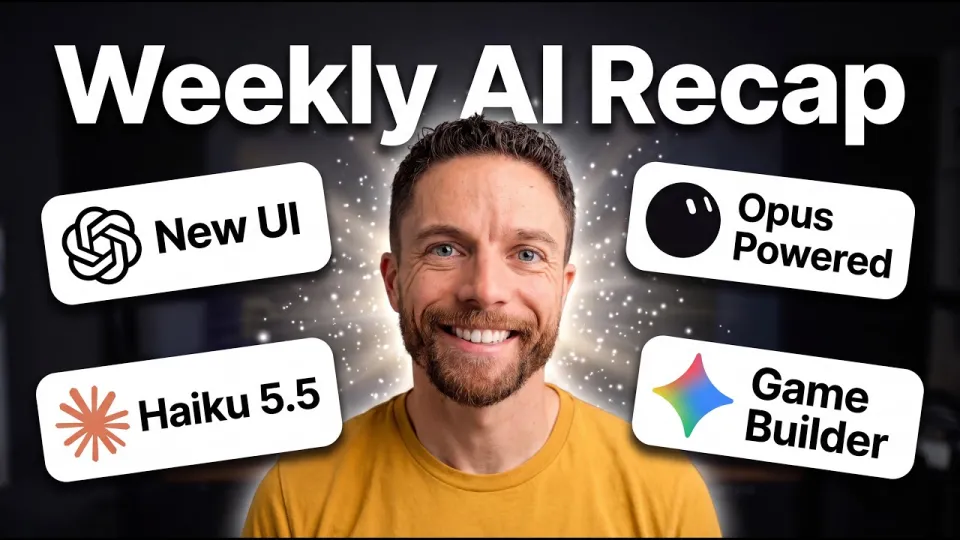
AI news this week centers on three shifts: Grok Bot opening up to rival models such as Claude, ChatGPT rolling out a redesigned Intelligent UI, and Claude Cowork moving its agentic workspace into the cloud. The same cycle brought Gemini plan changes and Nano Banana 2.1, all bundled into the weekly recap from Paul J Lipsky, whose sponsor link for the Okou launch offer is available at the Okou signup page.
What the Grok Bot Claude integration actually changes
Grok Bot is xAI's agent layer for delegating real work, and the headline claim is that it will be able to call on outside models and services rather than staying inside the Grok family. According to the recap, that list includes Claude for reasoning and writing tasks, Midjourney for image generation and Suno for music, which turns Grok Bot from a single-model assistant into a router that picks a tool per job.
Why that matters in practice:
- Model choice becomes a routing decision, not a brand loyalty question — the agent picks whichever engine fits the task.
- Outputs get stitched together across modalities: a script from one model, visuals from another, audio from a third.
- Users stop juggling five tabs and start supervising one workflow, which is exactly the pattern viewers describe when they hand Grok Bot a folder of raw footage and get back a finished social video with a voice script.
That last example is the real signal. The interesting part is not that an agent can generate a video, but that it accepted a messy input (a shared photo folder), asked for a human recording, then improved on the result. The bottleneck moves from production to direction.
ChatGPT's Intelligent UI rewrites the front door
The ChatGPT redesign, described as an Intelligent UI, changes how the product presents itself: instead of a single blank prompt box, the interface surfaces models, tools and modes more explicitly. For anyone who has watched ChatGPT accumulate features faster than menus, this is a usability correction as much as a cosmetic one.
What to check after the update:
- Which model is selected by default, and whether the picker is now visible rather than buried.
- Where tool modes (search, image, code, agent-style tasks) live and whether they persist between sessions.
- Whether saved preferences survive the migration — a redesign that resets defaults quietly costs users time.
A UI change sounds minor next to model launches, but it decides which capabilities people actually use. Features nobody can find do not exist.
Claude Cowork leaves the desktop for the cloud
Claude Cowork is Anthropic's workspace for handing off multi-step tasks, and the update moves it from a local setup to a cloud-hosted one. The practical consequence is that delegated work no longer depends on your laptop staying open, awake and connected.
That shift matters for three reasons. Long-running jobs become feasible, because a task that takes an hour does not compete with your battery. Collaboration becomes simpler, since work is not tied to one machine. And reliability improves, because a closed lid no longer kills a job mid-run.
The trade-off is trust: cloud agents ask for credentials, file access and permission to act on your behalf. Before delegating anything sensitive, decide what the agent may touch, what it must ask about, and where its output lands. Viewers repeatedly ask for a plain-language walkthrough of Claude Code, which suggests the real gap is not capability but onboarding — people want to know how to supervise an agent before they let it run.
Gemini plan changes and Nano Banana 2.1
Google's week was about packaging as much as models. The recap covers adjustments to Gemini subscription plans and the arrival of Nano Banana 2.1, the next iteration of Google's image generation line. One point raised in the comments is worth flagging for anyone comparing tiers: higher storage bundles and Pro-tier model access can be bundled together, so read the plan table rather than assuming the cheapest tier includes the top model.
On the image side, iterative releases like Nano Banana 2.1 tend to improve prompt adherence, text rendering and editing consistency rather than reinvent the model. The useful test is your own workflow: a product shot, a poster with legible type, a character kept consistent across three images. Run those before deciding whether to switch tools.
The recap also includes hands-on time with Google Playground, which is the right instinct — demos flatter new releases, and only repeated real tasks reveal where a model quietly fails.
Common questions from people following the AI news cycle
The most frequent doubts around this week's AI news are practical rather than technical. A recurring one is what a newly appeared bot inside an assistant actually is; several users deleted an unfamiliar agent assuming something had gone wrong, and could not restore it afterward. The lesson is to identify a new agent before removing it, since these rollouts often arrive without warning.
Other recurring questions:
- Can a single agent really replace a paid freelancer? Sometimes, for templated deliverables — but the human still supplies direction, judgment and final approval.
- Do I need to be a developer to use agent tools? No, but you need to be specific about inputs, permissions and the definition of done.
- Are weekly recaps enough to keep up? They are enough to know what changed and what deserves a closer look; they are not a substitute for testing a tool on your own work.
- Should I switch plans the moment a new tier appears? Compare model access and storage against your actual usage first.
The common thread: capability is arriving faster than the guidance for using it, which is why format matters — a structured rundown keeps the chaos legible.
How to turn this week's AI updates into a working setup
A concrete routine beats passive reading. Start by auditing which tools you already pay for and which capabilities you actually use weekly, because overlapping subscriptions are the most common hidden cost in an AI stack. Next, pick one agent — Grok Bot, Claude Cowork or an equivalent — and give it a single bounded task with a clear finish line. Then check the output against what you would have accepted from a contractor.
If the result holds up, expand scope one step at a time: add a second tool, then a longer-running job, then a shared folder. Keep a short log of what worked, what needed re-prompting and where permissions got in the way. That log is worth more than any launch announcement, because it tells you which parts of the stack are load-bearing for your work and which are novelty.
Final takeaway
This week's AI news points in one direction: assistants are becoming routers that combine models, and the interface is finally catching up to the capability underneath. Grok Bot reaching for Claude, Midjourney and Suno, ChatGPT rebuilding its front door, Claude Cowork moving to the cloud and Google reshuffling Gemini tiers all describe the same trend — orchestration over single-model loyalty. The winners will be users who define tasks clearly and supervise output, not those who collect the most subscriptions. Paul J Lipsky's weekly recap remains a useful way to track that shift, and if you want to test the workflow side yourself, start at Okou's registration page.
Questions & answers
Is Grok Bot really going to use Claude, Midjourney and Suno?
The weekly recap reports that Grok Bot is preparing to route tasks through third-party models and services including Claude, Midjourney and Suno. Treat it as a reported plan rather than a shipped feature until you see the integrations live in your own account, and check which tools are available on your plan.
What is the ChatGPT Intelligent UI and why does it matter?
It is a redesign of ChatGPT's interface that makes model selection, tools and modes more visible instead of hiding them behind a single prompt box. It matters because discoverability decides usage: capabilities users cannot find effectively do not exist for them.
Do I need coding skills to use agent tools like Claude Cowork?
No, but you need to be precise. Agents work best when you specify the input, the permissions they may use and the exact definition of done. Many viewers ask for a non-technical walkthrough of Claude Code precisely because the barrier is onboarding and supervision, not programming.
Should I upgrade my Gemini plan because of the new tiers and Nano Banana 2.1?
Compare the plan table against your real usage first. Higher tiers can bundle more storage with access to Pro-level models, so verify what is included rather than assuming the cheapest option covers everything. Then test Nano Banana 2.1 on your own image tasks before switching workflows.
Source: Weekly AI Recap: GrokBot Just Did the Unthinkable, ChatGPT Looks Completely Different & More! · Markdown version